How to acquire a public company by acquisition of shares in Bangladesh?
An acquisition of shares may take place either through subscribing to a company’s future earnings growth or through buying existing equity from another shareholder in the venture. For mergers and acquisitions, by filing its most recent annual report, the company must keep up to date. Any transfer of shares must be registered at the Joint Stock Companies Registrar’s Office. (In 2019, the previous requirement to receive approval from the Bangladesh Security Exchange Commission for the issue of shares resulting in a particular threshold being crossed by the paid-up capital of non-listed companies was abolished.)
How amalgamation of companies work through a High court order in Bangladesh?
Following a court order, the target entity merges into the purchasing entity and the target is then disbanded. Both of the target company’s assets and liabilities vest in the buyer. Purchase compensation is paid to the owners of the target company by the purchaser, either by allocating shares or by paying cash for the value of their shares. Mergers under the head of amalgamations are primarily regulated by the Companies Act 1994. Such amalgamations are expected to be approved by the High Courts of Bangladesh. Following the approval of the amalgamation by the court and upon approval by at least 75% of the shareholders, the transferee may offer 21 days’ notice to acquire the shares. The transferee company can acquire the shares unless the opposing shareholders have otherwise applied to the court within 30 days of receipt of the notice. A appeal to the appropriate High Court for orders to convene meetings of shareholders and creditors to obtain their approval must be made for a merger. A majority representing 75 percent of the value of the shareholders and creditors present and voting at the meetings must approve the scheme. A petition must subsequently be filed with the High Courts requesting approval of the scheme.
NGO registration in Bangladesh- A complete guide in 2023- Everything you need to know
Tahmidur Rahman, Senior Associate, TR Barristers in Bangladesh
2 Jan 2020
This post in details will explain in details about NGO and INGO registration in Bangladesh, the timeline, the concerns and types of NGOs , NGO's Affairs Bureau, key parts of theForeign Donations (Voluntary Activities) Regulations Act, 2016 (FDRA)Act, and the compliances to maintain with Joint Stock Companies and Firms, Department of Social Services with clear directions and infographics.
[lwptoc _builder_version="3.0.47"][/lwptoc]
NGO's in Bangladesh
Non-governmental organizations (NGOs) play an significant role in developed countries ' economic growth. They provide services to society through community development welfare work, national disaster assistance, sustainable system development, and grassroots movements. They are taking numerable steps to improve our community.
With the record of being the most densely populated nation on earth and a poor workforce, Bangladesh faces a huge challenge to meet the demands of its ever-increasing population.
For coping with such population, Organisations are working as the foundation of society. There are several types of organizations, but under the main heading, they can be categorized into three parts:
Government organisations,
private organizations and
non-governmental organisations.
NGO's have a positive outlook to the society compared to two other wings of the societal organisations. Many activists also dream of making their own NGO to improve society, but by no way build a child's play. Now, to grasp the whole premise, we will need to recognize a few things.
What is an NGO?
The Non-Governmental Organization is a legal body that is not a direct member of the government, independent of government power, and not a direct political competitor.
The NGO was first formally visualised in Article 71 of the Charter of the United Nations, which states: 'The Economic and Social Council may make appropriate arrangements for consultation with non-governmental organisations.'
A non-governmental organization is a legal body that is not a direct part of a government, independent of government control, and not a direct political competitor.
Differences between an NGO and other organisations
In Today's world, modern organisations are very nuanced in terms of thoroughness, for example, NGOs are working with the government, and some of them are also binding.
So things blur time to time, in general, NGO's are considered to be non-profit, non-government-dependent, and to serve their specific function, but they may be a helping hand of the government, collect money, and make profit in order to fulfill their function.
They may not abide by company law or business law, but may be interested in the business as a separate agency of a related NGO. So close observation is required on both the de facto and the de jure activities of the NGO.
Thus, it can be inferred that the process of creation, the mission and the activities of an entity are the final proof that it is an NGO; that it must not be a completely viable business agency, or that it must serve the purpose of its constitution and function accordingly to the part of the government under which it operates for government purposes.
On the basis of funding, we can further extend the scope of NGOs, such as locally sponsored, government-funded, foreign government-supported, national and international organizations. NGOs conventionally cover a wide range of sectors.
Typical NGO and INGO programs in Bangladesh are:
BINGO: business-friendly international NGO (example: Red Cross)
ENGO: environmental NGO (Greenpeace and World Wildlife Fund)
GONGO: government-organized non-governmental organization (International Union for Conservation of Nature)
INGO: international NGO (Oxfam)
QUANGO: quasi-autonomous NGO (International Organization for Standardization [ISO])
In addition to that the other general scopes are:
Human Rights
Woman Rights
Humanitarian Situation
Health issue
Education Sectior
Responding to health crises
Environmental issues
Economic programs
Skills development
Local development
Addressing Social issues
Religious perspective ( support and help)
Research purpose
Survey and Study
If you want to know how to open a company in Bangladesh or about company formation click here!
To get an NGO or an INGO registered in Bangladesh or an organization willing to operate or obtain foreign funding for the purpose of undertaking or carrying out any voluntary operation, it is imperative that such an organization be registered with the authority concerned and comply with the Government's requirements.
According to the laws of Bangladesh, the term "voluntary activity" can be specified as "an activity undertaken or carried out by any person or organization of his or her own free will to provide agricultural, relief, missionary, educational , cultural, vocational, social, welfare and development services, and includes any activity that the Government can, from time to time, consider to be a Voluntary activity."
NGO and INGO registration in Bangladesh
Any entity whose activities fall within the ambit of the definition mentioned above needs to have it registered to carry out its operation in Bangladesh.
In order to register an International Non-Government Organization (INGO) or local based Non-Government Organization (NGO), an application needs to be filed with the concerned authority.
The NGO Affairs Bureau (NGOAB) (which is under the Ministry of Social Welfare of Bangladesh) and the Ministry of Home Affairs shall be the relevant authorities in Bangladesh in this regard.
However, for example the Ministry of Health & Family Welfare or Ministry of Disaster Management and Relief or any other relevant authority which administers the entity’s activity shall also play a vital role.
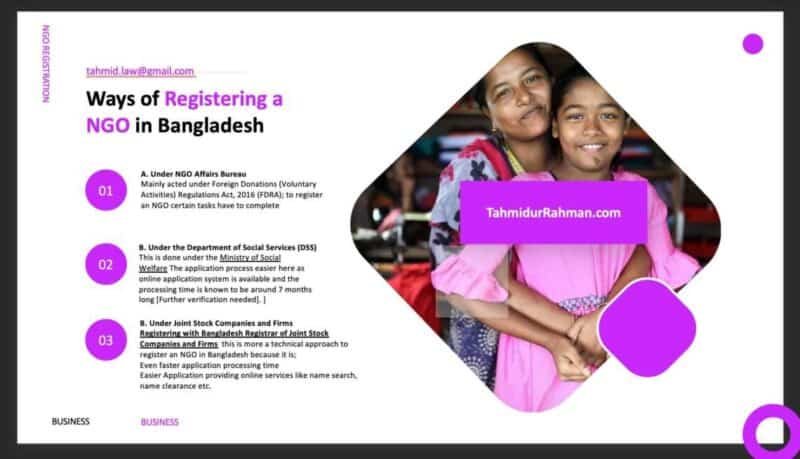
An NGO in Bangladesh can be registered in three ways:
Firstly, the registration of the INGO or the NGO must be carried out by the body of the NGOAB concerned. Application in the specified form shall be made to the NGOAB along with payment of the required fee and all related documents such as operation report, letter of intent, constitution, copy of the Treasury Challenge with respect to payment of registration fees, etc.
Upon submission of the application to the NGOAB, it shall be forwarded to the Ministry of Social Security and also to the Ministry of Home Affairs for review and inspection of the documents submitted.
Upon receipt of the papers, the Ministries concerned shall nominate the Special Branch of Police and National Security Intelligence to carry out a security check on the applicant and on such a matter of inspection as clearance forwarded to the Ministry of Home Affairs, provided that the approved bodies are pleased with their enquiries.
Once the approval has been issued to the NGOAB, it shall continue with the audit and final inspection of the documents. Acted mainly under the International Donations (Voluntary Activities) Regulations Act, 2016 (FDRA); to register an NGO, certain tasks must be completed; (as stated in section 4 of the FDRA) :
FD-1 Form (signed by Chief Executive in Bangladesh) – 9 copies
Certificate of incorporation in the Country of origin – 3 copies
Constitution – 4 copies
Activities Report – 6 copies
PIan of Operation (Work/Organogram) – 4 copies
Decision of the committee/ Board to open an office in Bangladesh – 4 copies
Letter of Appointment of the Country Representative – 4 copies
Copy of Treasury challan in support of depositing 50000 Taka for local NGO and USD $ 9,000 or Equivalent TK amount for foreign NGO in the Code 1-0323-0000-1836 and 15% Vat Code No (1-1133-00 35 -0311) – 3 copies
Section 3 of the Act made it necessary for NGOs to register where there is some international transaction. This act shall take precedence over all other current and relevant legislation.
Officials are to verify documents and authorize the NGO for a term of 10 years. It must be re-submitted in order to renew period 6 months before the end of the 10-year term. It placed certain barriers under section 5 to accept donations from certain individuals.
Section 6 stipulated that the appointment of International Consultant, Advisor or Officer and International Tours must be notified by the Government of their security clearance.
Section 9 for the management of the account of foreign donations, as well as for each NGO and person, shall maintain its accounts in the specified manner and prepare an annual statement of accounts; (section 12) for the approved audit firms.
Section 10 empowers the Government to carry out surveillance, monitoring and analysis of every NGO.
An NGO or charity can be registered with the Ministry of Social Welfare's Department of Social Services (DSS).
Registration, however, is only required for organizations that will provide welfare services to children, youth, women, families, physically or mentally handicapped, family planning, recreation, civic responsibility, released prisoners, juvenile delinquents, socially handicapped, beggars and the destitute, patients, the elderly or infirm, social work, or coordination of social welfare agencies.
Voluntary Social Welfare Agencies (Registration and Control) Ordinance, 1961, and related Rules, 1962.
Step 1: Obtaining name clearance from the appropriate office.
Step 2: Submit an application for registration to the authority using the prescribed form, 'Form-B.'
Step 3: Submit all required documents, along with 'Form-B.'
Step 4: Pay government fees such as Treasury challans, VAT, and so on.
Step 5: Application is forwarded to the appropriate Ministries.
Step 6: A security check is performed by a law enforcement agency, such as the Special Branch of Police or National Security Intelligence, among others.
Step 7: The Ministry inspects, monitors, and reviews the NGO.
Step 8: Review and final scrutiny by the DSS, followed by registration issuance if satisfied.
Step 9: The registration process with the Department of Social Services may take 5-7 months, depending on the circumstances.
1) Quicker response time for applications 2) Smoother application process:
The procedure is based on the SOCIETIES REGISTRATION ACT of 1860.The process of registration under the Societies Registration Act is as follows:
Seven or more persons associated in any literary, scientific, charitable, or other similar purpose may apply to the Bangladesh Registrar of Joint Stock Companies and Firms to form a society by subscribing to its memorandum of association, which must be accompanied by the society's rules and regulations.
Step 1: First, you need to get a name clearance like a company name clearance. The next step in the process is the actual application for registration of the entity. This request must be submitted on paper along with all the necessary documentation (and the approval of the name clearance).
Step 2: Submit an application to RJSC for registration, along with the Memorandum of Association and a Clearance letter, as well as all other required documents.
Step 3: Payment of government fees is the third step.
Step 4: A security check is performed by a law enforcement agency, such as the Special Branch of Police or National Security Intelligence, among others.
Step 5: Inspection, monitoring, and evaluation of the NGO by the appropriate authorities.
Step 6: If all requirements are met, the authority will issue a registration.
Process of Registration of an association in Bangladesh under the Companies Act:
According to Section 28 of the Companies Act, 1994, an association can be incorporated as a non-profit company conforming to the rules and regulations of a company with limited liability when it obtains a license from the concerned authority, namely the Bangladesh Registrar of Joint Stock Companies and Firms under the Ministry of Commerce.
The procedure for obtaining RJSC registration is nearly identical to that described above. The government will grant a license if it is satisfied that the association will promote commerce, art, science, religion, charity, or any other useful goals, and that its profits or income will be used to further those goals without paying any dividends to its members. These types of welfare-oriented businesses can be formed as limited liability companies under the Companies Act of 1994.
Registration of Trusts:
'A trust may be established for any lawful purpose, including charitable activity,' according to the law. The trustees are in charge of looking after and managing the trust property in order to achieve the goals stated in the trust deed.
A Trust can be established for any lawful purpose, such as the benefit of children, the public good, religious purposes, or any other purpose by interested persons, whether legal or natural, with specific property, whether moveable or immovable, or a fund for the benefit of the community. The trustee/s are responsible for the care and management of trust property in order to achieve the purposes stated in the trust deed.
Relevant Statutes: - The Trust Act of 1882:
The Trust Registration Procedure:
Step 1: A trust can be created through a trust deed that specifies the author's intention.
Step 02: In the trust deed, the author of the trust must state with reasonable certainty his intention to establish the trust, the purpose of the trust, the beneficiary, the trust-property, and transfers of trust property to the trustee.
Step 03: For the creation of a valid trust, certainty of words in unambiguous terms indicating intention, subject matter, and specific objective is required.
Step 04: The concerned organization can begin operations after the trust deed is registered. For example, trust deeds are registered at the Sub-Registrar Office where the NGOs' headquarters are located.
This Act provides for the registration of foundations, trusts, and other charitable organizations.
Charitable trust reporting regulatory authority:
There is currently no regulatory authority to which charitable trusts are required to report, so registration or license from other Non Profit Organization regulatory or registration authorities is required for their smooth operation. Trusts are required by law to report to that authority in such cases.
Trusted management of NGOs or charities:
A Board of Trustees manages a trust by protecting the trust property and enhancing it to its maximum benefit, as defined in the trust deed.
Registration for Waqf:
The concept of Waqf in Muslim Law is similar to the concept of trust in English. In this case, the owner of a property, both movable and immovable, can create a waqf for the use of beneficiaries in perpetuity through a declaration in an instrument. In accordance with the terms of the waqf instrument, the waqf is administered by a trustee known as a mutawalli.
Concerning Legislation:
Waqfs Ordinance of 1962
Registration Procedure for Waqf:
Step 1: The Mutawallis waqf property must file an application with the Waqf Administrator's office.
Step 2: Upon receipt of the application, the Administrator will proceed to register the waqf property, after which he will keep detailed information about it in his register, including the deeds, the name of the mutawalli, and the rules of succession to the office of mutawalli.
Shortcomings and Recommendations:
Various NGOs or charities have been formed and run under the aforementioned Acts, but these same Acts have been causing complications at this time.
It should be noted that there is no uniform law governing the formation of an NGO; rather, different types of laws, rules and regulations, and bodies govern the formation of the same, depending on its nature, objectives, purposes, constitution, resolutions, and so on. As a result, a consolidated uniform law is critical for the smooth formation, operation, and legalization of NGOs in Bangladesh.
"As per, Foreign Donations (Voluntary Activities) Regulations Act, 2016 (FDRA), under section 2(1) and foreign donations under section 2(5) which is very important to operate an NGO in Bangladesh."
Frequently Asked Questions about NGO and INGOs in bangladesh
In regards to NGO registration in bangladeshpeople also ask these questions frequently, hence this FAQ content block is dedicated to answering your questions.
General Questions about NGO registration in bangladesh
What is the rule of a NGO?
Every NGO in Bangladesh is legally mandated to document the Memorandum of Understanding. It includes the name and address of the NGO, the mission and goals, specifics of the governing body, information on human resources and personnel, rules and regulations, administrative laws and procedures.
How many NGO's are there in Bangladesh?
3000+.
Currently, approximately 3000+ (including local and international) NGOs are registered under the legislation of Goverment of Bangladesh. A total of 240+ foreign Non-government organizations (NGO) of 30+ countries have been operational in the country
Which is the biggest NGO in Bangladesh?
Based on the number of employees, BRAC is considered as the largest NGO (non-governmental development organisation) in the world not only in Bangladesh!
What is the model NGO guide?
United Nations Model NGO Guide. Since the founding of the United Nations, NGOs have been core members of the policy and implementation process. NGOs or non-governmental organizations are non-profit organisations focused on humanitarian, human rights and sustainable development issues around the world.
How many members there should be in my NGO?
Conventionally there shhould atelast be 7 members . There is no upper limit on the number of members of the group. These members have different designations which can be determined between them.
What is the head of an NGO called?
The Board of Directors of the NGO is at the top. The NGO Board is a legal requirement in most countries to be formally registered with local authorities. Most NGOs stipulate that membership of the Board is voluntary and non-remunerative. Board meetings shall be held closed, while written processes, reports and minutes may be made available for the purposes of accountability.
Who are considered as top managements of a NGO?
The top management of an NGO consists of three entities -
the Board of Directors,
the General Assembly, and
the Executive Director.
Who are responsible for the day to day functioning of an NGO?
The staff members of the NGO shall be responsible for the day-to-day operation and execution of its programs and projects. They report to the Executive Director, who is ultimately responsible for the operations of the NGO. (See Figure 3) The staff members of the NGO fall into three groups-responsible for activities related to (1) management, (2) advertisement and (3) programs / projects.
How do NGO's get funding in Bangladesh?
NGOs in Bangladesh may receive, coordinate and collect funds through a variety of sources, procedures, initiatives, ventures and activities: grants through funding agencies through ventures. Grant from the International Development Agency and Fund Raising from the Corporate Department under the CSR.
What are the differences between a NGO and a Non-profit?
The NGO is a non-governmental organisation. A non-profit organization uses the excess funds for the benefit of the organization, rather than splitting them between the members and the owners of the company. Examples of NPOs are performing arts organisations, trade unions and charities.
The legal team of Tahmidur Rahman, TR Barristers in Bangladesh TRW are highly experienced in providing all kinds of services related to registering NGO, non profit and charitable trust in Bangladesh . For queries or legal assistance, please reach us at:
E-mail: info@trfirm.com Phone: +8801847220062 or +8801779127165
Liquidation or Winding up a company in Bangladesh | Solvency declarance, Board meeting, declaration filings| Everything you need to know.
Tahmidur Rahman, Director and Senior Associate
12 Nov 2019
This post in will explain in details about the process of Liquidation or winding up a company in Bangladesh – This article will explain the step by step process of winding up a company office in Bangladesh, Declaration of solvency , accounts and audit, extraordinary general meeting, declaration of solvency and everything you need to know and to be aware of.
Table of Contents
Liquidation or Winding up a company in Bangladesh- Find the subsections below, If you want to jump through specific sections instead of reading the whole article.
What is Liquidation or Winding up a Company? And how a Liquidation or winding up works?
Winding up is the process of dissolving a company. A business organisation stops doing business as normal when it winds up. Its conventional aims are to sell off stock, pay off creditors and transfer to partners or shareholders any remaining assets. The term is used mainly in UK where liquidation is synonymous with the process of turning assets into cash. In other terms, this mechanism generates a monetary fund in which a business pays its debts, outstanding bills, and splits the remainder and distributes to shareholders, members of the corporation, investors, or any other investor. A receiver may be designated to control such asset distribution (known as “Liquidator”) process.
Process of Liquidation or Winding up a company in Bangladesh
Before we deep dive into the process of winding up a company in Bangladesh, it is pertinent to note the term used here is Company but not businesses, as sole proprietorships or partnership business in Bangladesh do not follow the equivalent pathway or practice such as liquidation or winding-up. Therefore, to continue with the liquidation process one must have or have an operating company, properly incorporated / registered under Bangladesh law.
Under the company law 1994, there are three modes of winding up a company in Bangladesh. The winding up of a company may be either:
by the court or
voluntarily or
Subject to the supervision of the court.
Who can file the petition of winding up in Bangladesh?
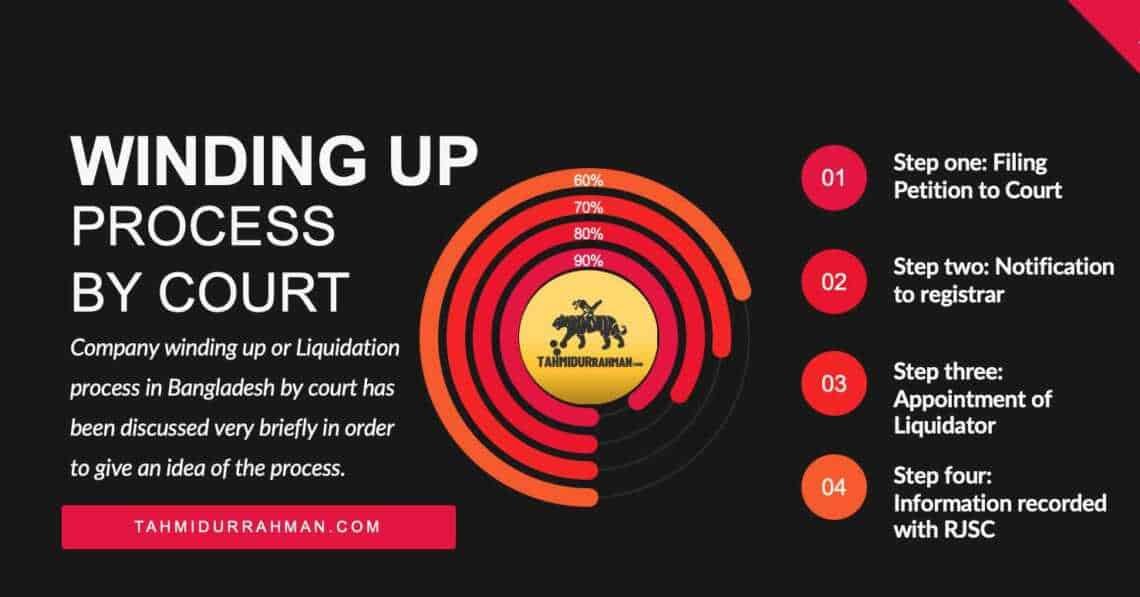
In order to wind up a company by the court, a petition has to be filled the company court of High Court Division of Supreme Court . It is to be noted that winding up of a company by the court shall be deemed to commence from the time of presentation of petition for winding up. Upon hearing the application the court will pass an order for winding up of the company.
Step two: Notification to registrar
In issuing a winding-up order, the petitioner and the corporation are obliged to file a copy of the order with the Registrar within 30 ( thirty) days from the date of the request. The Registrar shall register a summary in his company related books upon filing a copy of a winding-up order. The registrar then notifies the official Gazette that such an order has been made. Such an order shall be considered to be a discharge notice to the company’s employees, except when the company’s business is continued.
Step three: Appointment of Liquidator
The court will then appoint an official liquidator and the liquidator will perform its duties as per the Companies Act 1994. In case of winding up by the court, all the property and effects of the company shall be deemed to be in the custody of the Court as from the date of the order for the winding up of the company.
Step four: Information recorded with RJSC
Once a company’s affairs have been completely wound up, the Court shall make an order to dissolve the company from the date of the order, and the company shall be dissolved accordingly. Official liquidator shall report the order to the registrar within 15 (fifteen) days of the order. The registrar shall record a minute of the company’s dissolution in his books.
If you want to know how to open a company in Bangladesh or about company formation click here!
Voluntary Liquidation or a winding up a company in Bangladesh
A company may be winded up voluntarily:
when the period, if any, fixed for the duration of the company by the articles expires or any event occurs for which the articles provides that the company is to be dissolved and the company in general meeting has passed a resolution for winding up voluntarily;
if the company resolves by special resolution that the company be winded up voluntarily;
if the company resolves by extraordinary resolution to the effect that it cannot by reason of its liabilities continue its business, and that it is advisable to wind up.
It is to be noted that commencement of voluntary winding up shall be deemed to commence at the time of the passing of the resolution for voluntary winding up. (Liquidation or Winding up a company in Bangladesh)
Company Winding up process subject to Court in Bangladesh
When a company has by special or extraordinary resolution resolved to wind up voluntarily the court may make an order that the voluntary winding up shall continue but subject to supervision of court and such terms as the court thinks just.
Section 242 of the Companies Act 1994 takes into account whether a corporation is found to be unable to pay its debts. This will be the case if a creditor to whom the company is indebted for a sum and the company fails to pay the sum for three weeks or if the execution or other proceedings issued under a decree or order of any court in favor of a company creditor are returned unsatisfied in whole or in part or if it is demonstrated to the court’s satisfaction that the company is unable to pay its debts and the court is to take account of them.
Section 316-321 of the 1994 Companies Act deals with turning up being subject to court oversight. If a company has agreed to wind up voluntarily through special or exceptional means, the court may make an order that the voluntary winding up must proceed but be subject to court oversight and such conditions as the court considers appropriate. Where an order for winding up is made subject to supervision, the liquidator may exercise all the powers, subject to any limitation imposed by the court, as if the company were being wound up voluntarily entirely. (Liquidation or Winding up a company in Bangladesh)
How to get a Trade License in Bangladesh?
Click here and go to the post, Tahmidur Rahman speaks in details about Trade License in Bangladesh | Fees, Processing and Renewal!
Steps by Step process of voluntary Winding Up a Company in Bangladesh
This is the liquidator ‘s responsibility in any voluntary winding-up to settle the company’s debts and change the creditors’ right among themselves. Here is the comprehensive step-by – step method of voluntary wind-up of a bangladesh company.
Step One: Drafting documents for Winding Up
The first step on the process of winding up is to prepare documents. The documents that need to be prepared are:
Declaration of Solvency, (which includes information such as the company has no debts among other things) and
Profit and Loss Account and
Audited Balance.
The above mentioned documents will have to be approved by the majority directors of the company.
Step Two: Submission to RJSC
The next step is to file the approved Declaration of Solvency to the RJSC within 5 (five) weeks from the approval by directors.
Step Three: Pass Special Resolution
The third step requires the Extraordinary General Assembly to pass a special resolution. This is to approve the company’s decision to wind down and the liquidator appointment. It should be noted that the meeting ‘s content is also to be filed with the RJSC. The special resolution will then be published in the official Gazette, and in a newspaper circulated in the district where the company’s registered office is located. It will be achieved within 10 ( ten) days of the special resolution passing it.
Step Four: Appointing Liquidator
Once the chosen liquidator has been approved by the extraordinary general meeting and the liquidator has accepted the appointment, such must be notified to the RJSC. In addition, the Deputy Commissioner of Taxes will also be informed of the same within 30 (thirty) days of the said appointment.
Step Five: Final Report by Liquidator
At this stage the liquidator need to prepare a Final Account. The Final Account must have the details of how the winding up has been conducted and the assets distributed. Thereafter, the liquidator will call an extraordinary general meeting and the notice for that must be circulates by advertisement in the official Gazette, and in a newspaper. Such a notice must be given not less than one month before the meeting.
The special resolution will be passed in the extraordinary general meeting with regards to the disposal of the books and papers of the company.
Step Six: Documents filing to RJSC
Lastly, a final meeting must be hold and a return of the meeting must be submitted to the RJSC upon which the company will be winded up. The submission must be made within one week of the meeting.
Step Seven: Petition filing to Court for Winding Up
For voluntary winding up, the petition to the court is made at this stage. All the documents relevant to the winding up of the company are submitted to the court. The court being satisfied, declares that the company has been dissolved. This stage is essential to avoid any allegation of fraud later on.
If you want to know how to seamlessly transfer the share of a company click here!
2. For Trade Organization and Foreign Company: BDT 10.00
Liquidation or winding up a company in Bangladesh services in TR Barristers in Bangladesh
Tahmidur Rahman | TR Barristers in Bangladesh, a leading Company law firm can provide following the legal services: The Law firm will assist in arranging the actual consent and interest of each company share. Furthermore, TRW will provide a complete road map for winding up processes. Team TRW may also help in the disposal of company properties and make use of the proceeds to pay creditors. In addition , the team will assist in holding creditors’ meetings, settling legal disputes and settling all the company’s pending obligations. TRW will be responsible for sending the documents to RJSC and preparing all documents in Bangladesh for the termination or liquidation of the company. On top, the company law department will provide the complete legal services in relation to Company winding up or Liquidation process in Bangladesh.
For queries or legal assistance, please reach us at:
E-mail:info@trfirm.com Phone:+8801847220062 or +8801779127165 (WhatsApp also available)
Address: .
Liquidation or Winding up a company in Bangladesh.
“For voluntary winding up, the petition to the court is made at this stage. All the documents relevant to the winding up of the company are submitted to the court. The court being satisfied, declares that the company has been dissolved. This stage is essential to avoid any allegation of fraud later on. .”
If you want to know how to open a company in Bangladesh or about company formation click here!
Case Brief Preparation for Supreme Court Bangladesh: A Comprehensive Guide Preparing an effective Case Brief for the Supreme Court of Bangladesh is a fundamental skill for young lawyers and legal practitioners. Known locally as ব্রিফ বা কেস স্টাডি প্রস্তুতি, this…
Court Craft and Etiquette for Bangladesh Lawyers: Mastering কোর্ট ক্রাফট ও শিষ্টাচার in the Supreme Court For any legal professional aspiring to excel in the judiciary of Bangladesh, understanding Court Craft and Etiquette for Bangladesh Lawyers—or কোর্ট ক্রাফট ও…
Photocopy Permission for Affidavit in High Court Bangladesh: A Comprehensive Guide In the judicial system of Bangladesh, understanding the nuances of Photocopy Permission for Affidavit in High Court Bangladesh is essential for lawyers, litigants, and law students…
Pass Over and Not Today in Bangladesh Courts: Usage and Rules Explained In the procedural landscape of Bangladesh’s judiciary, understanding specific court terms such as Pass Over (পাস ওভার) and Not Today is essential for both young lawyers and clients navigating the…
Mentioning a Matter in High Court Division Bangladesh: Understanding Mention (মেনশন) and Its Essentials In the practice of law in Bangladesh, mentioning a matter in High Court Division Bangladesh is a fundamental procedural tool that enables advocates to bring urgent…
Maiden Appearance in Bangladesh Supreme Court: Understanding Its Significance and Procedure In the legal landscape of Bangladesh, the concept of Maiden Appearance (মেইডেন অ্যাপিয়ারেন্স) holds a pivotal place, especially within the highest echelons of the judiciary…
Understanding Review Petition Supreme Court Bangladesh: A Comprehensive Guide The review petition Supreme Court Bangladesh plays a crucial role in the legal framework, offering parties an opportunity to seek reconsideration of judgments or orders passed by the Supreme…
Understanding the Chamber Court Appellate Division Bangladesh: A Comprehensive Guide The chamber court Appellate Division Bangladesh occupies a pivotal position in the country’s judicial hierarchy, serving as a specialized forum within the Appellate Division of the…
Understanding the Role of the Chamber Judge Bangladesh Supreme Court The term chamber judge Bangladesh Supreme Court refers to a unique judicial function within the highest judiciary of Bangladesh, where designated judges hear urgent or interlocutory matters in their…
Understanding the Criminal Petition for Leave to Appeal Bangladesh The criminal petition for leave to appeal Bangladesh is a critical legal remedy available to aggrieved parties seeking to challenge decisions of lower courts in criminal matters before the higher…
Comprehensive Analysis: the foundational principles and statutory provisions of the Public Procurement Act 2006 The landscape of public procurement in Bangladesh has undergone a profound transformation over the past two decades. The transition from the archaic…
Understanding Dual Nationality Laws in Bangladesh The question of whether having a second passport is allowed in Bangladesh is one of the most common inquiries among expatriates and diaspora communities. The short answer is yes, but it is subject to specific…
Comprehensive Analysis: the detailed operational procedures mandated by the Public Procurement Rules 2008 The landscape of public procurement in Bangladesh has undergone a profound transformation over the past two decades. The transition from the archaic Compilation…
What is a Dual Nationality Certificate (DNC)? A Dual Nationality Certificate (DNC) is an official document issued by the Government of Bangladesh that legally recognizes a person as a citizen of Bangladesh while simultaneously holding the citizenship of another…
Comprehensive Analysis: the legal procedures and strict timelines for lodging procurement complaints and appeals The landscape of public procurement in Bangladesh has undergone a profound transformation over the past two decades. The transition from the archaic…
Understanding the NVR Seal The “No Visa Required for Travel to Bangladesh” (NVR) seal is a highly sought-after endorsement for foreign citizens of Bangladeshi origin and their immediate family members. Stamped directly into a foreign passport, the NVR seal…
This post in will explain in details about Branch office registration in Bangladesh – This article will explain the step by step process for setting up a branch office in Bangladesh. In addition, people want to know the required cost and documents for a branch office registration in Bangladesh. This article will explain everything you need to know about branch office with directions and infographics.
A branch serves as an extension of its parent company, meaning, there will be no separate legal entity established. Its parent company is liable for the branch office’s debts or any other obligations and activities.
No operation in Bangladesh that is not expressly authorised by BIDA can be conducted by a Branch Office. A Branch Office is also expected to register with the Joint Stock Companies and Company Registrar and to comply with other legal formalities prescribed by the Companies Act 1994.
Allowed activities of a Branch office in Bangladesh
One of the major differences between a branch and a liaison / representative office is that a branch may engage in commercial activities with a prior approval from the Bangladesh Investment Development Authority (BIDA). The branch office, for example, can:
collect payments on behalf of the parent company
have local sources of income
make outward payments from Bangladesh with a prior approval from the BIDA
Documents to submit in BIDA for a Branch office in Bangladesh
A Branch or Liaison Office is a proper legal body in Bangladeshonce it is registered with the BIDA. It is called a multinational company extension, and not a separate legal entity. Unlike a Bangladeshi subsidiary, a Branch or Liaison Office parent company is indirectly responsible for all branch or liaison office debts and liabilities.
As per the guideline of BIDA, following papers/documents are required for application for opening of branch office. (4 copies of all documents).
1. Application in prescribed form signed by the authorized person for establishment of Branch office registration in Bangladesh.
8. Finally, Any other documents BIDA, may ask for after primary reviewing
In addition, you must translate any documents that are not stated in English before submission. (Branch office registration in Bangladesh)
Inspection of the Documents by the BIDA
When the documents are issued, they will be thoroughly reviewed by the BIDA Inter-Ministerial Committee. When the committee is content with the verification then they may give the approval or can obtain additional documentation. Hence it is important to carefully prepare the papers.
Time and governments cost for approval
The average time needed for submission and getting the approval is one month. However, BIDA may seek physical representation of the documents as such this may make the process lengthier. (Branch office registration in Bangladesh.)
The government cost for getting the approval from BIDA is USD 300 (three hundred dollar)
“Tahmidur Rahman Remura Wahid is Considered as one of the leading firms in Company Law in Dhaka, Bangladesh”
Step two- Opening Bank Account to set up branch office
Following approval from BIDA, the next move is to open a Bangladesh Bank Account. It is because while no minimum paid-up capital is needed for the establishment of a branch office, a remittance of US$ 50,000 must be deposited within 2 ( two) months from the date of issuance of the BIDA letter of authorisation. (Branch office Registration in Bangladesh )
a) Documents
The documents required for opening bank account are:
BIDA permission letter
Draft Article and Memorandum of Association
in addition, Passport of the bank account signatory (if foreign nationals) and
lastly, NID (if Bangladeshi national)
Step 3- Bangladesh Bank approval
Also in regards to Branch office registration in Bangladesh, Parliament of Bangladesh revised the 1947 ForeignExchange Regulatory Act. Now, however, Bangladesh Bank’scriteria for 18B approval has been withdrawn. In addition, according to the amendment, the branch office will report to the Bangladesh Central Bank after receiving approval from BIDA. Such a report with 30 ( thirty) days to approve should be made.
How to get a Trade License in Bangladesh?
Click here and go to the post, Tahmidur Rahman speaks in details about Trade License in Bangladesh | Fees, Processing and Renewal!
After obtaining approval from both Bangladesh Bank and BIDA, registration with the RJSC is required. The following documents will be required for this purpose (for Branch office registration in Bangladesh):
a) Documents:
BIDA and Bangladesh Bank approval letter
Certified copies of the Memorandum of Association and Articles of Association
Full address of the registered or principal office of the company
List of the directors and secretary (if any) of the company
in addition, the name and address of a Bangladeshi who may represent the company in processing and accepting documents and
Step five: Obtaining Trade License from the Local City Corporation
In order to get trade license an application need to be made to the concerned city corporation. Along with the application, the following information and documents need to be submitted:
a) Documents
Photocopy of AOA and MOA
Photo of Managing Director or Chairman
TIN of the branch office
in addition, Rental agreement of the office and
lastly, Nature of business
b) Time
It usually takes 3 to 4 working days to get a trade license. In order to know more about how to get trade license in Bangladesh.
c) Cost
The government for trade license is USD 100 (hundred dollar).
Step six: Income Tax Registration & VAT Registration for the branch office in Bangladesh
In order to carry out normal business operations in Bangladesh after setting up the branch office, it is essential that the branch office has a unique Business Identification Number (BIN). Therefore, to get a Business Identification Number, a VAT registration certificate need to be obtained from the Department of the National Board of Revenue (NBR).
Can a foreign employee be employed in Branch office?
Sponsors may apply for Private Investors Visa. Foreign employees can appointment. Appointment can be made by foreign employees. International workers need to get a work permit to be able to operate in Bangladesh. This is a multiple entry visa and it is only valid for 3 months but can be extended later.
A branch manager may be a foreigner but he / she should be a Bangladesh citizen. Remember also that a cap of 5 percent (five percent) of foreign employees in a branch is restricted by Bangladeshi law. In addition, it should be noted that as per the Bangladesh Investment Development Authority Handbook 2011, the
current maximum ratio of foreign to local employees is 1:5 for commercial offices and 1:20 for industrial enterprises. (Branch office Registration in Bangladesh)
Validity Period of Approval of Branch office registration in Bangladesh
The approval is usually provided to establish a branch for a period of three years and it has to be extended/ renewed. You have to apply for renewal or extension at least 2 (two) months before the expiry of the current term.
Capital requirement for branch office registration in Bangladesh
Time period to set up or a branch office registration in Bangladesh
To set up a branch office in Bangladesh, conventionally it takes from 60days (sixty) to 90 days (ninety) in total. Other formalities are consequential and will take about 2 weeks.
“Sponsors may apply for Private Investors Visa. Foreign employees can appointment.Appointment can be made by foreign employees. International workers need to get a work permit to be able to operate in Bangladesh. This is a multiple entry visa and it is only valid for 3 months but can be extended later.”
If you want to know how to open a company in Bangladesh or about company formation click here!
Business activities of a Branch office in Bangladesh
Branch office does not have its own independent legal body. This is because it functions as an extension of its parent company. Hence the parent company is entirely responsible for its branch office ‘s operations, debts and responsibilities.
Unlike liaison office, a branch office can engage in commercial activities. However, in order to do so, prior approval from the Bangladesh Investment Development Authority (BIDA) is required.
Activities that a Branch office can engage in are:
Payment collection on behalf of the parent company
Local sources of income for the branch office
in addition, Make outward payment from Bangladesh (with approval from BIDA)
Compliances to maintain as a branch office in Bangladesh
In the approval letter issued by BIDA, the activities of a Branch office shall remain confined to the areas and for the time specified and authorized. Unless the organization wishes to extend its Office past the approval period, they will have to apply for the required renewal / extension in the specified form with correct documentation at least 2 ( two) months prior to the expiry of the current term. In addition to that the Branch office should also maintain the following compliances:
Quarterly return of incomes and expenditures out of remittances received from abroad shall have to be submitted to the BIDA, concerned Bank, National Board of Revenue and Bangladesh Bank with documentary evidences under circular No 01/2009 amended circular No 03/2009 of 30th July, 2009.
Any change(s) of present address shall be intimated to the BIDA for necessary action and approval before the proposed change is carried out.
The permitted Office shall have to obtain clearances/ licenses from the concerned government agencies, as and where required, under the existing rules of the country.
The permitted Office shall have to pay duty/income tax/VAT/revenues and other taxes payable to the government under the existing laws of Bangladesh.
How to take the profit/dividend out from Bangladesh to the parent company?
At the end of the fiscal year, you can declare the company’s dividend and transfer the money to the account of the parent company.
Foreign capital invested in Bangladesh for industrial projects with government approval is permitted to be repatriated from Bangladesh, along with any capital appreciation, provided Bangladesh Bank approval is first obtained.
Remittance of dividends and profits is now permitted with fewer restrictions. Before profits from foreign subsidiaries can be transferred back to the parent company, Bangladesh Bank approval is required. First, taxes must be paid. Profit remittance requests must be submitted to the Bangladesh Bank via the applicant’s bank.
Repatriation of investments made in Bangladesh with the approval of the government of Bangladesh / Bangladesh Bank is permitted (except in cases where the investment was permitted on the specific condition that it would not be eligible for repatriation), provided the disinvestment was also made with approval.
Actual remittances will be permitted subject to the satisfaction of such conditions as to repatriation amount and installments, etc., as may be applicable from time to time.
With prior permission from Bangladesh Bank, foreign nationals temporarily residing in Bangladesh may transfer to their home countries current assets such as salary, dividend, etc. savings.
There are currently no restrictions on the receipt of remittances through proper banking channels from any foreign nation in Bangladesh. Additionally, there are no restrictions on the importation of foreign currency checks. Drafts in any foreign currency may be freely converted by authorized dealers.
Agreements for the remittance of fees for the purposes of royalties, technical know-how, and technical assistance do not require the prior approval of the BIDA if the total fees and other expenses associated with technology transfer (service fee, marketing commission, etc.) fall within the following limits.
Such fees and other expenses should not exceed six percent of the commercial value of imported machinery for new projects.
Recurring annual fees for royalties and other expenses, such as fees for technical know-how, technical assistance, operational services, marketing of products, etc., should not exceed a limit of 6 percent of the previous year’s sales reported on the tax return of the company.
Once the above-mentioned technical transfer agreements have been signed, they must be submitted to the BIDA for registration.
Proposals that fall within the prescribed limits will require the BIDA’s prior approval, for which an application must be submitted along with the required documentation and a copy of the relevant draft agreement.
Question
Answer
What is the legal process for registering a branch or subsidiary office in Bangladesh?
The legal process for registering a branch or subsidiary office in Bangladesh involves obtaining various approvals and registrations from different government bodies, including the Registrar of Joint Stock Companies and Firms, the Bangladesh Investment Development Authority, and the National Board of Revenue.
What is the difference between a branch office and a subsidiary office?
What are the documents required for registering a branch or subsidiary office in Bangladesh?
The documents required for registering a branch or subsidiary office in Bangladesh include a certified copy of the parent company’smemorandum and articles of association, a board resolution approving the establishment of the branch or subsidiary office, and other documents as required by the government bodies.
How long does it take to register a branch or subsidiary office in Bangladesh?
The registration process for a branch or subsidiary office in Bangladesh usually takes around 2-3 months, depending on the completeness and accuracy of the application and the workload of the government bodies involved.
What are the registration fees for a branch or subsidiary office in Bangladesh?
The registration fees for a branch or subsidiary office in Bangladesh vary depending on the capital investment and other factors.It is advisable to consult a lawyer or a business consultant to get an estimate of the fees.
Can a foreign company register a branch or subsidiary office in Bangladesh?
What are the tax implications of registering a branch or subsidiary office in Bangladesh?
A branch office is taxed on its worldwide income, while a subsidiary office is taxed only on its Bangladesh-sourced income.The tax rates and regulations may vary depending on the nature and size of the business.
What are the reporting and compliance requirements for a branch or subsidiary office in Bangladesh?
A branch or subsidiary office in Bangladesh is required to file annual tax returns, audited financial statements, and other compliance reports with the government bodies.Non-compliance may result in penalties and legal consequences.
Can a branch or subsidiary office in Bangladesh conduct business activities outside Bangladesh?
A branch or subsidiary office in Bangladesh can conduct business activities outside Bangladesh subject to compliance with the relevant laws and regulations of the countries involved.
What are the legal implications of registering a branch or subsidiary office in Bangladesh?
Registering a branch or subsidiary office in Bangladesh creates legal obligations and responsibilities for the parent company, including compliance with local laws, regulations, and business practices.It is advisable to consult a lawyer or a business consultant before proceeding with the registration process.
Company Law practice in TR Barristers in Bangladesh
The Barristers, Advocates, and lawyers at TRW Law chamber in Gulshan, Dhaka, Bangladesh are highly experienced at assisting clients in dealing with and registering branch offices in Bangladesh. For queries or legal assistance to set up a branch office in Bangladesh, please reach us at:
E-mail: info@trfirm.com Phone: +8801847220062 or +8801779127165 House 410, Road 29, Mohakhali DOHS